
You own the apartment. The hotel runs the business.
Imagine owning a luxury apartment in Victoria Island without searching for tenants, negotiating annual rent, advertising the property, chasing payments, organising guest check-ins, arranging housekeeping or coordinating the day-to-day operation yourself.
Now imagine that instead of being let to one tenant for one year, the apartment forms part of a professionally operated hospitality business that can accommodate many guests through the year. That is the basic idea behind a hotel-managed apartment.
It is not a new or uniquely Nigerian concept. Across established property markets, individually owned apartments and condominium units have been incorporated into hotel and resort operations through structures described as condo-hotels, rental pools, hotel apartments, serviced apartments and managed rental programmes.
For a buyer considering Reportage Tower, the concept can be understood simply. You own the apartment. The hotel operates the hospitality business. Guests pay for accommodation. The operating model creates revenue from that activity, and the owner participates in the economics of a professionally managed hospitality asset without personally becoming the hotel operator.
Buy
You select and purchase your apartment.
Own
The apartment is yours, subject to the applicable purchase and title documentation.
Hotel operates
A professional hospitality operation runs the accommodation business.
Participate
Guest revenue flows through the operating structure to the owner's share.
Why this differs from an ordinary rental apartment
Consider two owners. The first buys an apartment and lets it conventionally: finding a tenant, negotiating rent, executing a tenancy, collecting payments, handling repairs and complaints, managing renewals, absorbing vacancy and advertising again when the tenant leaves. The property may produce income, but the owner is still in the rental business.
The second owns an apartment that forms part of a hotel-managed operation. Instead of personally finding guests, the operation can provide reservations, marketing, housekeeping, guest services, check-in and check-out, hotel-standard maintenance, hospitality staff, corporate booking relationships, online distribution, pricing management and daily operational supervision.
- Hotel apartmentMany guests through the year
- Hotel apartmentHospitality accommodation revenue
- Hotel apartmentHotel reservations and booking channels
- Hotel apartmentOperator collects and reports revenue
- Hotel apartmentOperator manages continuous inventory
- Hotel apartmentDemand managed across market segments
- Hotel apartmentHotel-standard maintenance and housekeeping
- Hotel apartmentOwner is principally the property owner
Same real estate. Different operating model.
The commercial reason is straightforward. A conventional apartment usually means one apartment, one tenant, one tenancy. A hotel apartment can mean one apartment and many guests across many stays — a night, three nights, a week, a business trip, a corporate assignment, a conference, a weekend or an extended stay — with the operator managing that demand continuously rather than waiting for a single annual lease.
How money reaches the owner
The flow matters more than the headline percentage. Guest payments enter a hospitality business, that business carries real operating costs, and the owner's share is calculated according to a contractual formula.
- 1
Guest
A guest books and pays for accommodation.
- 2
Hotel operation
The operator manages rates, occupancy, distribution and service delivery.
- 3
Accommodation revenue
Room revenue is earned by the hospitality operation.
- 4
Operating structure
Management fees, staffing, housekeeping, marketing, utilities, maintenance and other operating costs are applied.
- 5
Owner's share
The remaining share is calculated and paid as defined by the applicable agreement.
International agreements make this explicit. The DAMAC managed rental scheme defines Net Revenue as pooled revenue after specified management fees, expenses and other costs, while Innisbrook calculates owner distributions from Adjusted Gross Revenues after defined deductions. For Reportage Tower, the revenue definition, deductions and payment mechanism should be read from the project's own documentation.
The international model
Hotel-apartment ownership is an established international structure. The legal and contractual detail differs considerably from market to market, so these examples illustrate the business model rather than the Nigerian legal position.
Dubai
Hotel apartments are a recognised ownership category
Dubai is the closest international comparison, not least because Reportage is a UAE-based developer. Dubai Law No. 6 of 2019 on jointly owned real property expressly defines a Hotel Project to include hotels, hotel villas, hotel apartments and hotel rooms intended for joint ownership, and recognises specialist Hotel Project Management Companies operating them.
Hotel operation is separately regulated. The Dubai Department of Economy and Tourism requires hotels to be licensed, inspected and classified before operating, and its classification framework applies to owners, management companies, investors and operators alike.
DAMAC has publicly filed a Managed Rental Scheme Agreement for serviced and hotel apartments in Dubai. It describes a developer selling a unit to an owner for use as a serviced or hotel apartment, the owner appointing a licensed manager to operate the rental scheme, revenue being pooled, and Net Revenue being calculated after specified management fees, expenses and other costs. In that agreement the management fee is stated at 5% of Total Pooled Revenue, the owner's share is paid quarterly on income actually accrued, owner occupation is permitted for a specified number of nights, and the manager is responsible for maintaining furniture, fixtures and equipment to required standards.
International industry example. These references describe how the model operates elsewhere; they are not statements about Reportage Tower's contractual terms.
Why Victoria Island matters
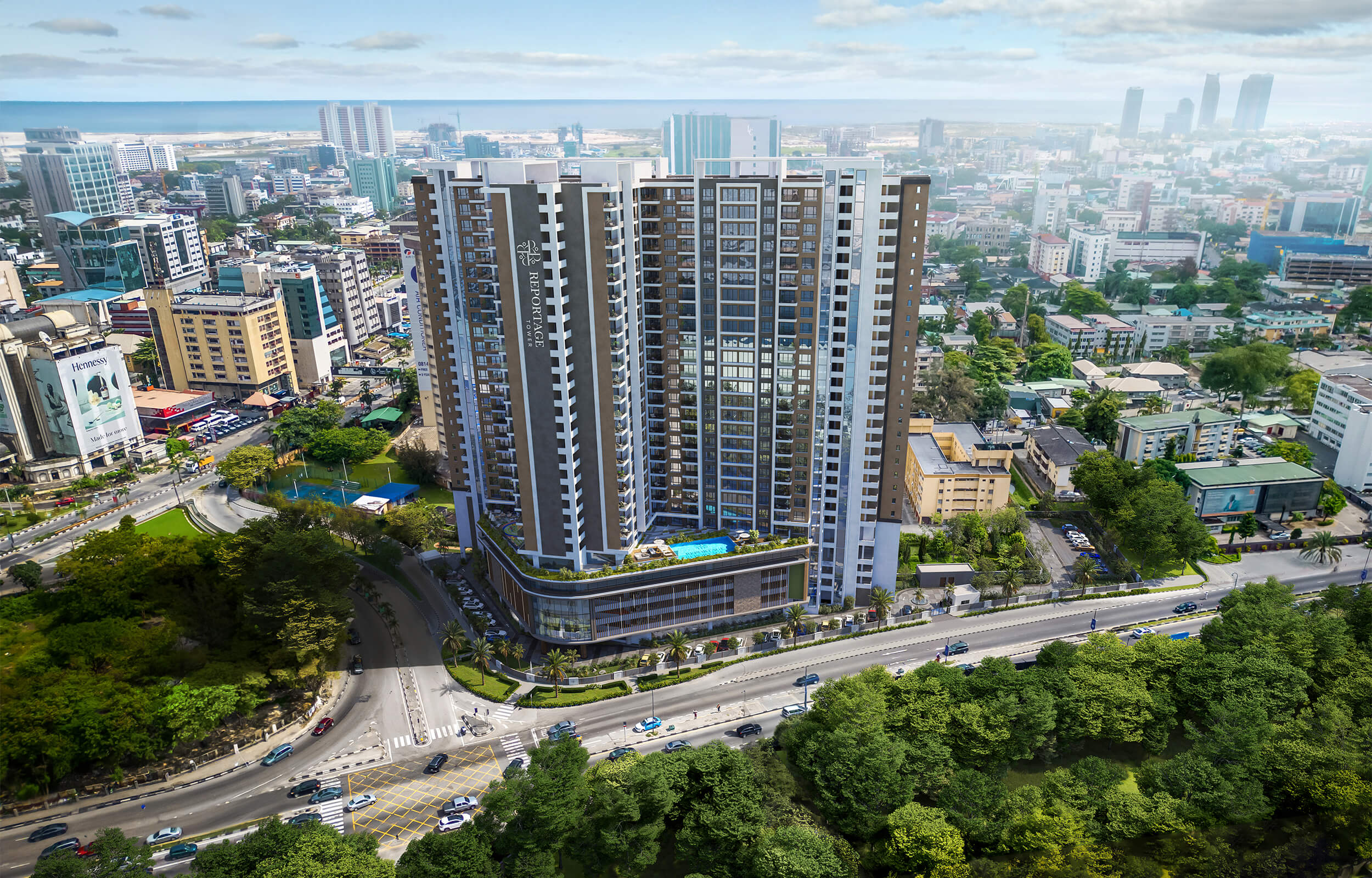
Reportage Tower stands on Ozumba Mbadiwe Avenue in Victoria Island. Reportage's official factsheet describes a high-rise hotel-apartment development with 611 units, 27 residential floors and a plot area of approximately 5,689.6 sqm, with a concierge-style reception, infinity pool, gym, retail and commercial outlets, conference facilities, premium housekeeping, international facility management and operation by an international hotel brand.
The location is not incidental. A conventional residential apartment is marketed mainly to people seeking a home. A hotel apartment can be marketed to business travellers, corporate clients, international and domestic visitors, consultants, executives, event attendees, families and both short and extended-stay guests — a broader demand pool that suits a commercial district.

A hotel is also not simply collecting annual rent. The operator manages room rates, occupancy, booking channels, guest turnover, seasonal and corporate demand, promotions, hotel services and availability. That flexibility — responding to demand rather than waiting for a lease renewal — is one of the commercial reasons for using a hospitality model at all.
What the 18–22% projection really means
The project is being marketed in Nigeria as offering up to 18–22% projected annual return. The right way to read that is as a projection — an estimate of what the investment could produce under the assumptions used by the project — rather than a guaranteed payment or a bank interest rate.
The more useful question is not whether 20% is possible, but what operating performance produces it. The hotel must generate enough accommodation revenue to cover the whole operating structure — management, staff, housekeeping, marketing, booking distribution, utilities, maintenance, replacement of furnishings, service charges and applicable statutory charges — before the owner's share is calculated.
“The intelligent question is not ‘is 20% possible?’ — it is ‘what operating performance produces the 20%?’”
Illustrative calculation
What a projected percentage represents
Projected annual rate
Projected annual amount at 20% of $250,000
$50,000
Indicative monthly equivalent $4,167. Naira equivalent about ₦68,750,000 at ₦1,375/$1.
Illustrative calculation only. This shows the arithmetic of applying a stated percentage to a purchase price. It is not a statement that any Reportage Tower apartment will produce this amount, and it is not a guarantee. The applicable calculation basis, deductions and payment terms should be read from the project's financial projection and contractual documents.
Owner use, maintenance and resale
Ownership does not necessarily mean giving up personal use. The DAMAC managed rental agreement, for example, permits owner occupation for a specified number of nights subject to its conditions, and illustrates the economic logic: when the owner occupies the apartment, the owner's revenue share can be affected, because the hotel cannot sell that night to a guest. For Reportage Tower, the exact number of owner nights and the applicable conditions should be taken from the project's own documents.
Maintenance is one of the clearest practical differences from a privately managed flat. In mature hotel-apartment arrangements the operator's role can extend to maintaining the unit, its furniture and equipment, arranging repairs, upholding hospitality standards and coordinating housekeeping and guest services, with contribution mechanisms set out contractually.
Resale remains available. You retain the right to sell or transfer the apartment, subject to the applicable requirements. A future buyer will usually be assessing both the real estate and the operating arrangement attached to it, because in a hotel-apartment structure the operation forms part of the property's economic identity.
- Confirm what you are buying and the applicable title documentation.
- Confirm who operates the property and under what agreement.
- Confirm how accommodation revenue is defined and what is deducted before the owner's share.
- Confirm the payment frequency and reporting you will receive.
- Confirm the owner-use entitlement and how it affects your share.
- Confirm maintenance, furnishing replacement and service-charge responsibilities.
- Confirm the resale and transfer requirements before you commit.
Reportage Tower brings the model to Lagos
You do not need to become a hotelier to own hotel real estate. You do not need to manage guests, run a booking platform, organise housekeeping or negotiate every short stay. The hotel operation exists to perform those functions. Your role is principally that of the property owner; the operator's role is to run the hospitality business; the guest's role is to be the customer. That separation is what makes the model work at scale.
Reportage Tower allows an owner to combine a prime Victoria Island apartment with the operating capability of a hotel, creating the potential for recurring hospitality income while retaining exposure to the underlying real estate. The development's title is a Lagos State Certificate of Occupancy (CofO), and the project is currently at piling stage as of September 2026.
A hotel-managed apartment should not be assessed as though it were an ordinary residential flat. The right questions are: what do I own, who operates it, how does the hotel make money, how does that revenue reach me, what services are provided, what personal-use rights do I have, what happens when I sell, and what happens to the property's value while I hold it. Once those are answered, the model becomes straightforward.

Property
Hospitality
Professional management
Income potential
Capital value
= The hotel-apartment model
Questions buyers ask
What exactly do I own in a hotel-managed apartment?+
You own the apartment itself as real estate, subject to the applicable purchase and title documentation. At Reportage Tower the development's title is a Lagos State Certificate of Occupancy (CofO). The hotel operation is how the apartment is operated — it is not a substitute for your ownership.
Is this an established model or something new?+
It is well established internationally. Dubai law expressly recognises hotel apartments within jointly owned Hotel Projects, the United States has run condominium-hotel rental programmes for years, and current US public-company filings continue to disclose active rental programmes involving individually owned condominium units.
Why not simply rent the apartment traditionally?+
A conventional tenancy places one tenant in the apartment for a fixed term, and the owner handles sourcing, rent collection, renewals, repairs and vacancy. A hotel operation markets the same apartment to many guests through reservations, corporate accounts and booking channels, and manages pricing and turnover continuously.
How does money actually reach the owner?+
Guests pay for accommodation, the hotel operation earns that revenue, contractual deductions such as management fees and operating expenses are applied, and the owner receives the share defined by the applicable agreement. The precise revenue definition, deductions and payment frequency should be read from the project's own documentation.
Does the 18–22% figure mean guaranteed income?+
No. It is a projected annual return marketed for the project, not a guaranteed payment and not a bank interest rate. It depends on hotel performance and the applicable contractual terms.
Can I still stay in my own apartment?+
Hotel-apartment structures commonly provide a defined owner-use entitlement. International agreements show that when the owner occupies the unit, the owner's revenue share can be affected, because the apartment is not available to a paying guest that night. The exact number of nights and conditions for Reportage Tower should be taken from the project's own documentation.
Who handles maintenance and housekeeping?+
In mature hotel-apartment arrangements the operator maintains the unit, its furniture, fixtures and equipment to hospitality standards, arranges repairs and coordinates housekeeping and guest services. Contribution and cost mechanisms vary and are set out in the applicable documentation.
Can I sell the apartment later?+
You retain the right to sell or transfer your apartment, subject to the applicable requirements. Because the hotel operation forms part of the property's economic identity, a future buyer is typically assessing both the real estate and the operating arrangement.
Sources and further reading
- Reportage Tower official project page and factsheet
- Dubai Law No. 6 of 2019 on jointly owned real property
- Dubai Department of Economy & Tourism — hotel licensing and classification
- DAMAC Managed Rental Scheme Agreement (public filing)
- Hyatt Miami at The Blue condominium-hotel rental programme
- SEC-filed US condominium-hotel management agreement
- Sotherly Hotels 2025 Annual Report
- Innisbrook 2025 Rental Pool financial disclosures
- UK Government serviced-apartment and aparthotel guidance
- Australian Securities & Investments Commission RG 140
- Singapore Urban Redevelopment Authority serviced-apartment framework