
On this page
One number follows Reportage Tower everywhere it is discussed: a projected annual return of 18%–22%.
By itself that number tells an investor very little. The useful question is what would have to happen inside the building for an apartment to generate that level of income.
To answer it, you have to start at the other end of the transaction — with what a guest is willing to pay for a night.
Illustrative economics — not a forecast
The question behind 18%–22%
An owner’s income comes from one thing: people paying to stay in the property. Everything else — the brand, the lobby, the pool, the concierge — exists to support the nightly rate and the occupancy behind it.
So instead of asking whether 22% is realistic, ask what combination of nightly rate, occupancy, operating margin and owner profit share would be required to produce it on the price you actually pay. That is a question you can calculate.
Section 02
Why an ordinary shortlet is the wrong benchmark
There is a tendency in Lagos to compare every apartment investment with the cheapest available shortlet. A ₦150,000-a-night three-bedroom in Victoria Island may be perfectly good accommodation. That does not make it the benchmark for a residence operated to international hospitality standards.
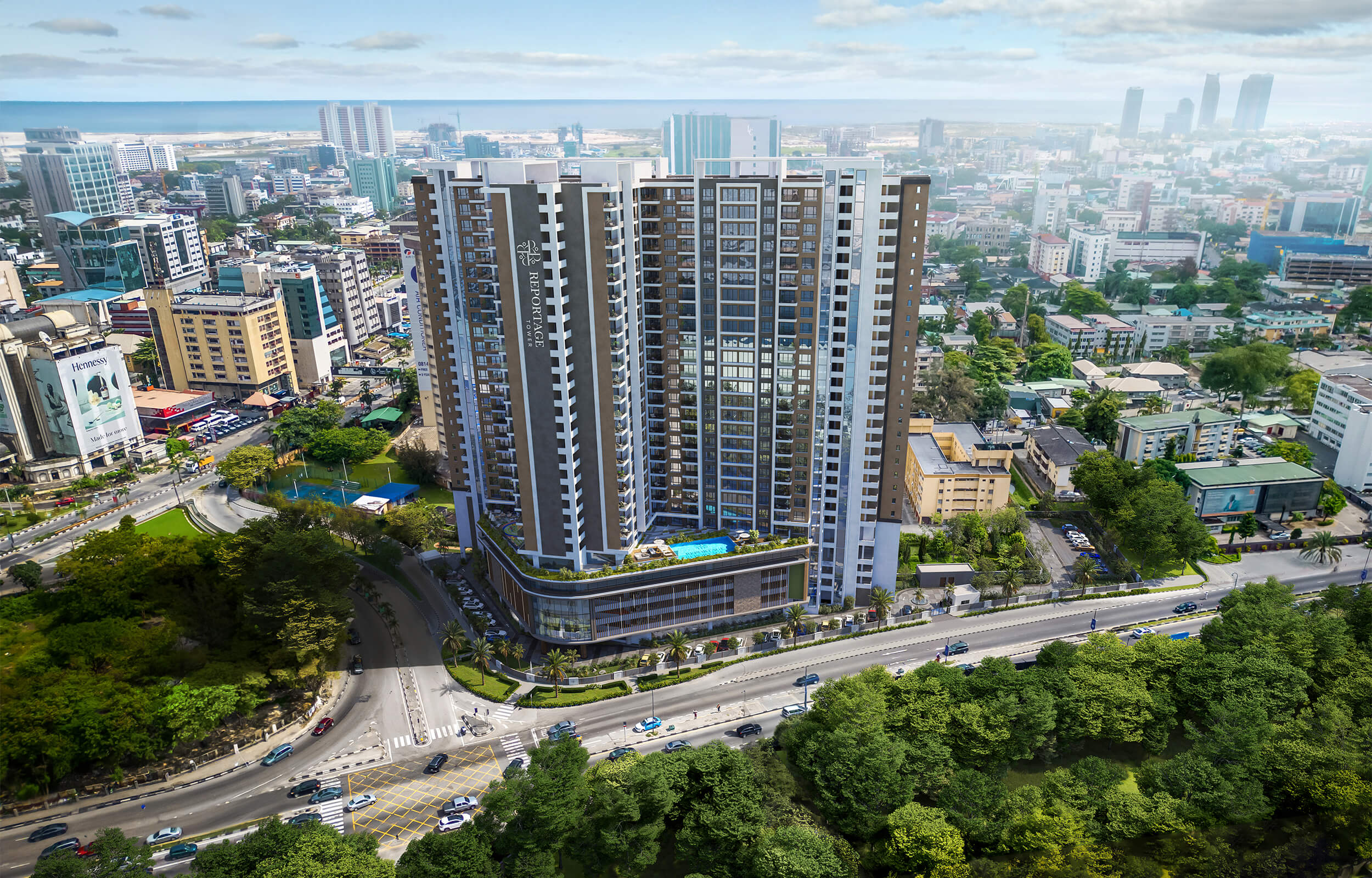
Reportage Tower is published as a hotel-apartment development: 611 apartments across 27 residential floors, with studios and one, two and three-bedroom residences, alongside a grand lobby, pool, gymnasium and conference facilities. The published project information describes a hotel-management arrangement with the operator still to be confirmed.
A three-bedroom residence of that type also should not be mentally priced like a standard hotel room. A single room with a bathroom is a different product from multiple bedrooms, multiple bathrooms, living and dining space, a kitchen, a terrace where applicable, housekeeping, concierge and building amenities. At the top of the branded market, large-format suites in Lagos already run past 200 sqm — closer to a luxury residence delivered through a hotel platform than to a room.
A Reportage Tower three-bedroom should be evaluated as a luxury residence plus hotel service plus professional management plus a Victoria Island address — not as a conventional shortlet.
Section 03
The market floor, not the ceiling
AOP Homes Advisory tracks privately operated serviced apartments in Victoria Island. Comparable three-bedroom apartments of around 140 sqm, with private kitchens, balconies and in one case a private pool, are currently tracked at roughly US$230 to US$240 a night before applicable taxes.
Those figures are useful, but they should be read correctly. They tell us guests are already paying more than US$200 a night for privately managed three-bedroom accommodation in Victoria Island. They do not tell us what a professionally operated hotel apartment should charge. They are a floor for apartment-style accommodation, not a ceiling for branded hospitality.
Tracked advertised nightly rates, AOP Homes Advisory — Market Tracking, September 2026. Advertised rates are not confirmed transaction rates.
Section 04
Nightly rate and occupancy scenarios
The table below is arithmetic, not a forecast. It shows the gross accommodation revenue an apartment would produce at a given average realised nightly rate and a given occupancy level. Nothing here is a Reportage Tower projection.
| Average nightly rate | 60% occupancy (219 nights) | 70% occupancy (256 nights) | 75% occupancy (274 nights) |
|---|---|---|---|
| US$300 | US$65,700 | US$76,500 | US$82,200 |
| US$400 | US$87,600 | US$102,000 | US$109,600 |
| US$500 | US$109,500 | US$127,500 | US$137,000 |
| US$600 | US$131,400 | US$153,000 | US$164,400 |
| US$750 | US$164,250 | US$191,250 | US$205,500 |
Gross accommodation revenue before operating costs, management fees and the contractual profit split. Owner income is materially lower than these figures.
Section 05
Operating costs and the owner’s share
Gross revenue is not owner income. The hotel has to operate: staff, housekeeping, utilities, marketing, reservations, maintenance and management fees are paid first. What remains is divided between owner and operator under the applicable agreement.
The table applies an illustrative 60/40 owner-operator split to a US$400,000 purchase, so you can see how the same headline revenue produces very different returns depending on the operating margin.
| Gross revenue | Operating costs | Operating profit | Owner at 60% | Return on US$400,000 |
|---|---|---|---|---|
| US$150,000 | US$70,000 | US$80,000 | US$48,000 | 12% |
| US$180,000 | US$80,000 | US$100,000 | US$60,000 | 15% |
| US$200,000 | US$80,000 | US$120,000 | US$72,000 | 18% |
| US$213,000 | US$79,667 | US$133,333 | US$80,000 | 20% |
| US$230,000 | US$83,333 | US$146,667 | US$88,000 | 22% |
This is the part most headline yields skip. A high nightly rate does not automatically equal a high investor return — the operating structure decides how much of it survives to the distribution.
An investor looking at a hypothetical 60/40 split may ask why 40% goes to the operator. The relevant question is what remains for the owner after paying someone to build and run the hospitality business, because an apartment does not become a continuously marketed hospitality product on its own. An operator brings:
- International distribution
- Brand positioning
- Reservations and sales
- Corporate relationships
- Revenue management
- Housekeeping and guest services
- Staffing and training
- Technology and systems
- Maintenance and quality control
Section 06
Bringing in the purchase price
A return is a fraction, and the denominator matters. Two investors buying at US$150,000 and US$425,000 cannot be handed the same expected income; the larger acquisition needs a larger income stream to produce the same percentage.
| Purchase price | 18% income | 20% income | 22% income |
|---|---|---|---|
| US$150,000 | US$27,000 | US$30,000 | US$33,000 |
| US$200,000 | US$36,000 | US$40,000 | US$44,000 |
| US$250,000 | US$45,000 | US$50,000 | US$55,000 |
| US$300,000 | US$54,000 | US$60,000 | US$66,000 |
| US$350,000 | US$63,000 | US$70,000 | US$77,000 |
| US$400,000 | US$72,000 | US$80,000 | US$88,000 |
| US$425,000 | US$76,500 | US$85,000 | US$93,500 |
Against the current AOP Homes price schedule for Reportage Tower — one-bedroom residences from US$201,250, two-bedrooms from US$304,750 and three-bedrooms from US$425,500 — a 20% return on a US$425,500 three-bedroom means roughly US$85,000 of annual owner distribution. That, in turn, implies about US$142,000 of distributable operating profit under a 60/40 split.
Supplied asking prices, September 2026. Price, floor, view and payment structure require current developer confirmation before reservation.
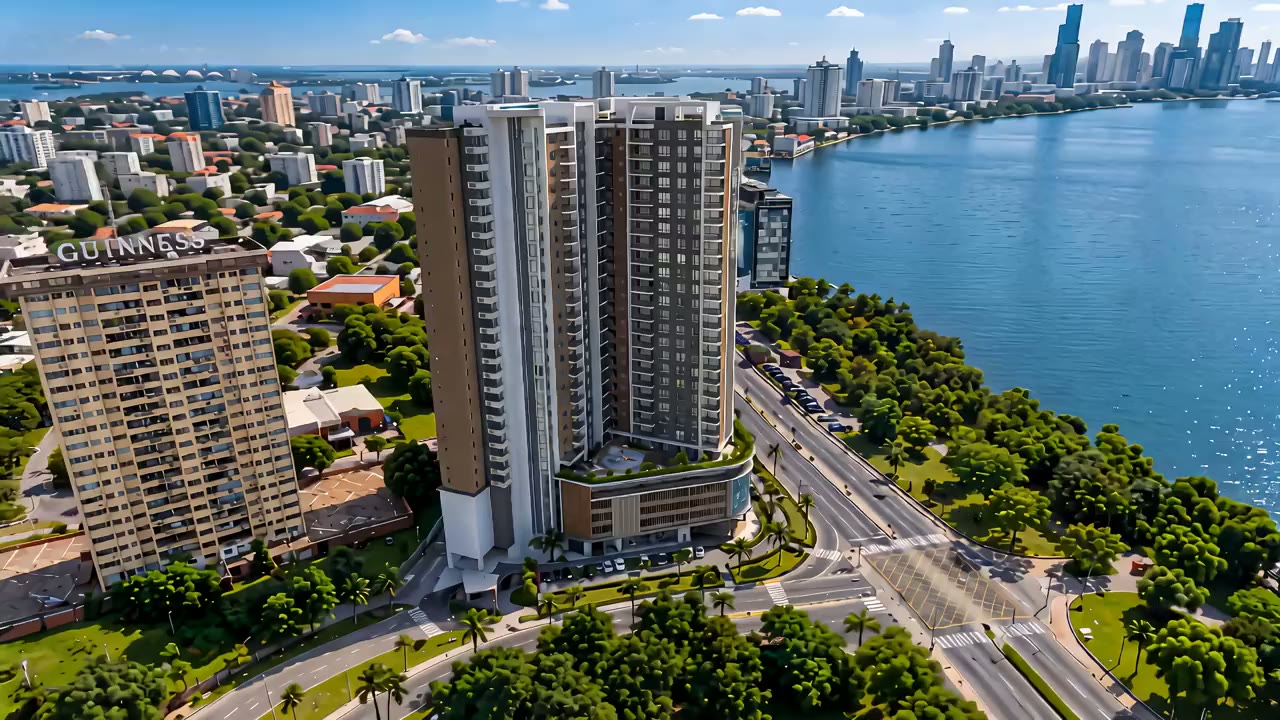
Represented by AOP Homes
Reportage Tower
Victoria Island · Availability by confirmation
Hotel-managed 1, 2 and 3-bedroom apartments with city and lagoon views.
From $201,250
Section 07
Work out your own numbers
Move the inputs to see what any combination of nightly rate, occupancy, operating margin, owner share and purchase price produces. Every output is arithmetic on your own assumptions.
Illustrative outcome
- Occupied nights a year
- 255 nights
- Gross accommodation revenue
- US$102,000
- Operating profit after costs
- US$56,100
- Owner distribution
- US$33,660
Return on purchase price
7.9%
An arithmetic illustration based on figures you choose. It is not a projection, an offer or a statement of expected performance for any apartment.
Section 08
Studio to three-bedroom economics
The revenue model does not have to be identical across the building. Each typology serves a different guest and earns in a different way.
Studio
A high volume of shorter stays at a lower nightly rate.
- Business travellers
- Solo executives
- Short-stay visitors
- Corporate guests
One bedroom
A broader guest pool, with longer average stays than a studio.
- Executives
- Couples
- Extended stays
- Diaspora visitors
Two bedroom
Fewer bookings, higher rate per booking, longer stays.
- Executives travelling together
- Families
- Corporate groups
- Premium leisure
Three bedroom
Closest to luxury residential hospitality rather than room accommodation.
- Families
- Senior executives
- Diplomatic guests
- Extended corporate stays
Section 09
Income is only half of it
An owner here is not buying a share of a hotel business. They are acquiring real estate, with a hospitality operation as the mechanism through which that real estate can generate income. That gives the investment two potential economic dimensions: the cash produced by operations, and the market value of the underlying apartment.
Neither is guaranteed. But once the building is operating, the numbers that decide an owner’s income are visible and can be monitored:
Don’t look at the return. Look behind the return.
Section 10
Method, assumptions and limits
- Every nightly rate, occupancy level, operating margin and profit split in this article is illustrative. None is a Reportage Tower forecast, an advertised rate or a statement of expected performance.
- The 18%–22% figure is a projected annual return supplied for the project. It is not guaranteed and not a bank interest rate.
- Comparable serviced-apartment nightly rates are advertised rates tracked by AOP Homes Advisory in September 2026, not confirmed transaction rates.
- Apartment prices are supplied asking prices from the current AOP Homes schedule and require developer confirmation before reservation.
- The binding revenue definition, deductions, owner-use entitlement, payment frequency and profit share are governed strictly by the executed sale and hotel-management documentation.
Questions
Frequently asked questions
Is the 18%–22% figure a guaranteed return?
No. It is a projected annual return supplied for the project. It is not a guaranteed payment and not a bank interest rate. Actual income depends on hotel performance, operating costs and the contractual profit-sharing terms set out in the sale and management documentation.
Will a Reportage Tower apartment achieve US$600 or US$750 a night?
Nobody can responsibly state that today, and this article does not claim it. The nightly rates shown are illustrative thresholds used to demonstrate the revenue an apartment would need to produce for particular levels of gross income. They are not forecasts or advertised rates.
Why not simply benchmark against a Victoria Island shortlet?
An independently managed shortlet establishes a market floor for apartment-style accommodation, not a ceiling for a professionally operated hotel apartment. Comparable serviced three-bedroom apartments in Victoria Island are already tracked at above US$200 a night, before any hospitality brand, concierge, housekeeping or amenity platform is added.
Does a high nightly rate automatically mean a high owner return?
No. Gross accommodation revenue is not owner income. Operating costs are paid first, and the resulting operating profit is then divided between the owner and the operator under the applicable agreement. A strong nightly rate with a weak operating margin can still leave a modest distribution.
Who will operate the hotel at Reportage Tower?
The published project information describes a hotel-management arrangement with the operator to be confirmed. AOP Homes does not publish an operator name until it is confirmed in writing by the developer.